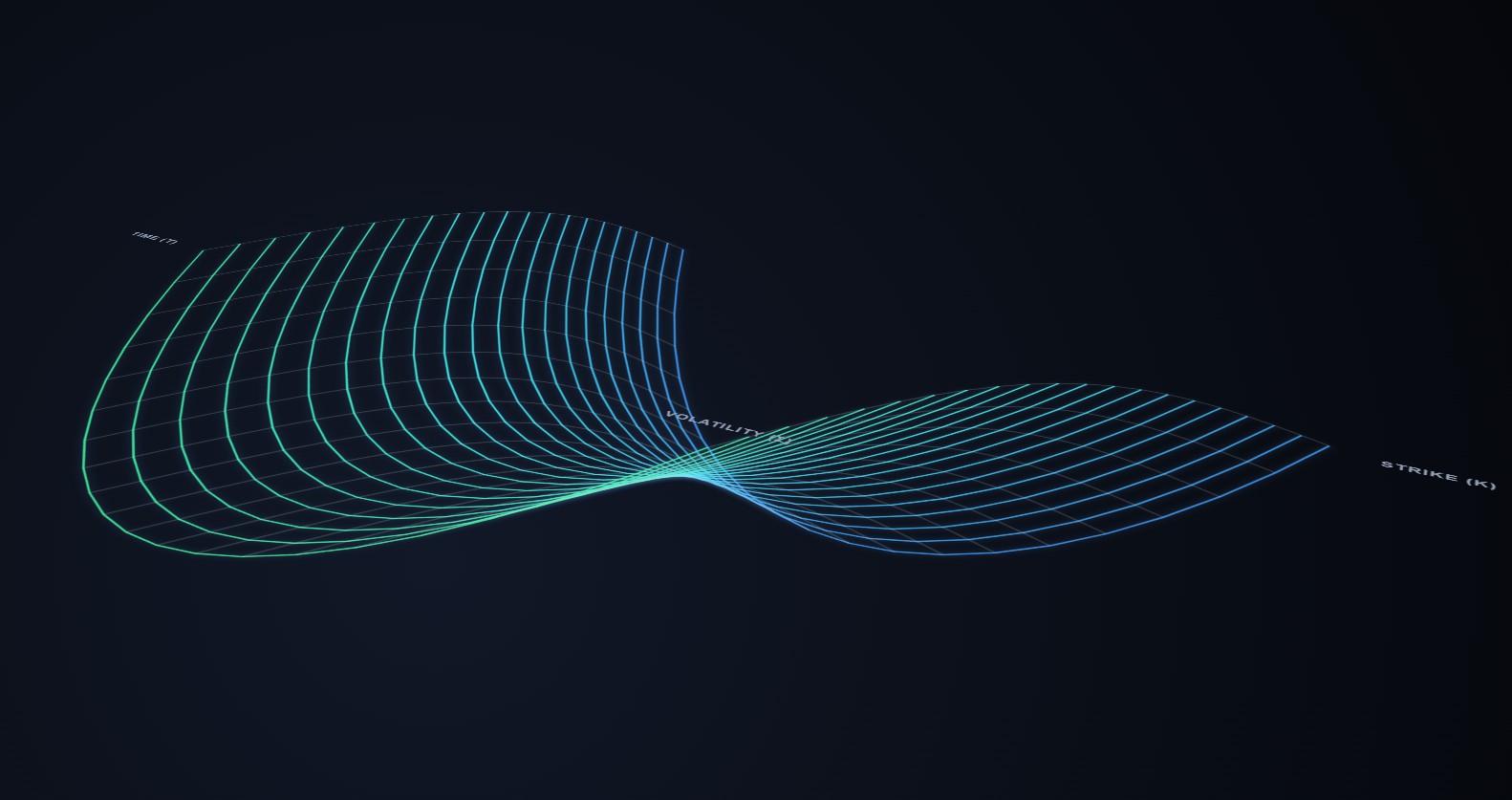
If you’re only looking at the premium of an option, you’re only seeing the surface. For a dealer or a financial engineer, the price is just a byproduct of several moving parts working in tandem. To truly understand an option’s behavior, you have to look under the hood at the Greeks, the mathematical DNA that dictates how a contract reacts to the chaos of the market.
If an option is a building, the Greeks are the structural stress tests. They don't just tell you that an option's value is changing; they tell you why. Is the position leaning into a directional move? Is the foundation of the trade rotting away due to time? Or is the value fluctuating simply because the market has "caught a fever" and volatility is spiking?
1. Delta (Δ) – The Directional Engine
The Formula
Where \(q\) is the dividend yield, \(\tau\) is time to expiration, and \(N(d_1)\) is the cumulative standard normal distribution function.
Where it Comes From
Delta is the first derivative of the option price (\(V\)) with respect to the price of the underlying asset (\(S\)):
The Philosophy
Delta represents the "equivalent position" in the underlying stock. Given a contract controls 100 shares, if an option has a Delta of 0.50 it moves roughly like 50 shares of the stock (contract multiplier of 100 x 0.50). Philosophically, it is often viewed as the theoretical probability that the option will expire in-the-money.
Dealer Risk Management
Dealers use Delta to achieve directional neutrality. If a dealer sells a call with a 0.60 Delta (or 60 Delta), they immediately buy 60 shares of the stock. This "Delta Hedge" ensures that if the stock price moves up, the loss on the call is offset by the gain on the shares. Conversely, if the stock price moves down, the loss on the shares is offset by the gain on the call.
Delta Curve: OTM to ITM
2. Gamma (Γ) – The Acceleration
Where \(N'(d_1)\) is the probability density function (PDF) and \(\sigma\) is the volatility.
Where it Comes From
Gamma is the second derivative of the price with respect to the underlying:
It is the derivative of Delta.
The Philosophy
If Delta is speed, Gamma is acceleration. It measures how fast your Delta changes. High Gamma means your risk profile is unstable and requires constant rebalancing.
Dealer Risk Management
Dealers hate "Gamma risk" because it makes delta-hedging difficult. In a high-gamma environment (near expiration), a small move in the stock requires a massive change in the hedge. Dealers manage this by "hedging their Gamma" using other options to smooth out the Delta's sensitivity.
Gamma: Exposure at the Strike
3. Theta (Θ) – The Silent Thief
The Formula
Where \(r\) is risk-free rate, \(K\) is strike price, and \(d_2 = d_1 - \sigma\sqrt{\tau}\).
Where it Comes From
The Philosophy
Options are "wasting assets." Theta represents the cost of time. It is the "rent" you pay to hold a directional view. For the option buyer, Theta is a daily loss; for the seller (the dealer), Theta is the daily income.
Dealer Risk Management
Dealers look at the Theta-Gamma trade-off. To earn Theta (income), they must take on Gamma risk. A dealer's goal is to ensure the income they collect from Theta is enough to cover the costs of rebalancing their Delta hedges.
Time Decay (Theta) Acceleration
4. Vega (ν) – The Fear Factor
The Formula
Note: Vega is often reported as % change per 1% change in vol (divided by 100).
Where it Comes From
The Philosophy
Vega measures the option's sensitivity to uncertainty. When the market gets nervous, Vega causes option prices to rise even if the underlying price hasn't moved.
Dealer Risk Management
Dealers manage "Vega Buckets." They track their volatility exposure across different expiration dates. If they are "Short Vega" in the 30-day bucket, a spike in market fear could cause massive losses, so they offset this by buying volatility elsewhere.
Vega: Volatility Sensitivity
5. The Esoteric Greeks
As we move into professional market-making, simple Greeks aren't enough. We need to measure how the Greeks themselves react to the market.
Vanna
Formula: \(\frac{\partial \Delta}{\partial \sigma}\) or \(\frac{\partial \nu}{\partial S}\)
Philosophy: Measures the sensitivity of Delta to Volatility.
Use Case: Critical for FX dealers. If the USDJMD volatility spikes, Vanna tells the dealer how their Delta hedge needs to change, even if the exchange rate is still the same.
Volga (Vomma)
Formula: \(\frac{\partial \nu}{\partial \sigma}\)
Philosophy: The "Gamma of Volatility." It measures the acceleration of Vega.
Use Case: Used to price the "wings" (deep OTM options). It explains why OTM options become exponentially more expensive when a crisis hits.
Charm (Delta Decay)
Formula: \(\frac{\partial \Delta}{\partial t}\)
Philosophy: Measures how Delta changes as time passes.
Use Case: Dealers use Charm to predict how much of their hedge they will need to sell or buy over the weekend when the market is closed.
The Volatility Smile (Volga's Result)
Volga explains the "curvature" of this smile—how OTM options carry higher relative volatility.
Conclusion: The Holistic View
No Greek exists in isolation. A good dealer is a "Risk Architect" who understands that a move in price affects Delta, which is accelerated by Gamma, while Theta bleeds the value and Vega fluctuates with market sentiment.
At Celeraq, we are building the tools to visualize these invisible forces, allowing Jamaican institutions to move beyond simple trading and into the realm of precise financial engineering.
Interactive Greeks monitoring and structural risk analysis are available on our Global Markets Platform.